

Secret Zero - An Obvious Solution
Table of Contents
What is Secret Zero?
In the realm of IT and security, “secret zero” refers to the initial bootstrap credential (or credentials) required to bring up a new deployment from scratch. Secrets classified as ‘secret zero’ are essentially the master keys that unlock further access or enable required functionality for an application.
This foundational set of secrets bootstraps secure communication and access to sensitive data, but it creates a chicken-and-egg dilemma: how do you securely manage the very first secret without exposing it? While secrets management tools like HashiCorp Vault or AWS Secrets Manager have revolutionized how we handle credentials, APIs, and tokens, secret zero remains a stubborn vulnerability lurking at the core of many projects.
The Pain Points
Secret zero isn’t just another password; it’s a high-stakes liability. Here are three critical pain points that make it a nightmare for organizations:
Single Point of Failure: If secret zero is compromised, attackers gain unfettered access to the entire vault of secrets, leading to cascading breaches, data theft, and potential system-wide shutdowns. In large infrastructures, this amplifies the attack surface, turning one weak link into a total compromise.
Exposure and Handling Risks: Often hardcoded in code, stored in environment variables, or manually entered during deployment, secret zero is prone to leaks via version control, insider threats, or interception during transmission. Traditional methods like static IPs or long-lived credentials fail in dynamic, cloud-native environments where resources spin up and down rapidly, increasing the risk of accidental exposure.
Management Complexity: Rotating, auditing, and controlling access to secret zero is fraught with challenges, especially in sprawling organizations with multiple environments (dev, test, prod). Balancing operational accessibility with security often leads to over-privileging or obscure practices that disrupt workflows, while coordinating across teams multiplies instances of secret zero, each a potential failure point.
NOTE Exposed secrets often remain valid for months, inviting exploitation and underscoring why secret zero demands urgent attention.
Industry Options: Partial Solutions
No silver bullet eliminates secret zero entirely, but several approaches mitigate its risks by shifting paradigms or adding layers of protection. Here are key some industry options:
Hardware Security Modules (HSMs): These tamper-resistant devices isolate secret zero in a secure physical environment, handling key generation and storage away from vulnerable software. While effective for high-security needs, they’re costly and complex, often used in hybrid setups with cloud services.
Cloud Key Management Services (KMS): Providers like AWS KMS, Google Cloud KMS, and Azure Key Vault offer scalable, API-driven management with automatic rotation and fine-grained access controls. They integrate natively with cloud resources, reducing manual handling, but still rely on initial IAM roles or identities for bootstrap.
Identity-Based Federation and Zero Trust: Moving away from secrets altogether, solutions like OpenID Connect (OIDC) federation, workload identity (e.g., in Kubernetes), and zero-trust architectures use continuous verification via trusted providers (e.g., AWS IAM roles, Azure AD). Pull-based models let services request secrets just-in-time, minimizing static credentials and enabling automatic rotation without restarts.
Tools like Infisical, GitGuardian, HashiCorp Vault, and Entro further enhance these by enriching secrets with anomaly detection and unified management for non-human identities.
A Simple Model for Credential Risk Scoring
When managing credentials across cloud platforms, CI/CD pipelines, and automation systems, it’s easy to lose visibility into which secrets are actually risky. A lightweight scoring model can help prioritize rotation and remediation by turning common security signals into a single numeric score.
The model below combines several practical factors into a 0–100 credential risk score, where higher values indicate greater risk:
Risk = Human Handling + Rotation Age + Storage Security + Blast Radius + Lifetime + Exposure − Automation
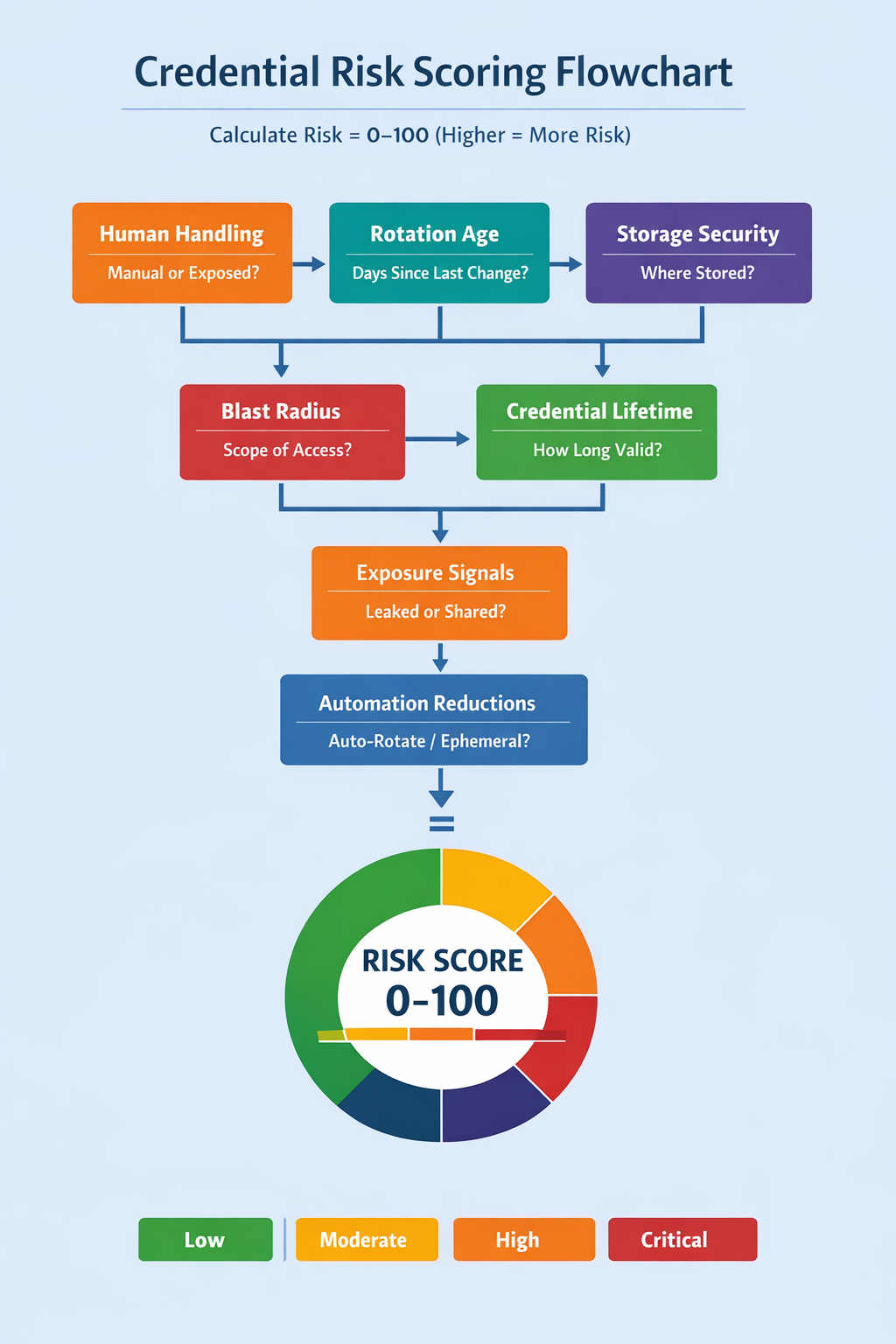
Each factor reflects a real-world contributor to credential compromise.
Key Risk Factors Explained
Human Handling
Credentials that are manually created, copied, or shared are significantly more likely to be exposed.
Examples of higher risk:
- Copy/paste into chat or documentation
- Manual creation outside automation
- Storage in plaintext files or notes
Fully automated credential generation and storage dramatically reduces this risk.
Rotation Age
The longer a credential exists without rotation, the more opportunity attackers have to discover or reuse it.
Typical guidance:
- Short-lived or automatically rotated credentials are low risk
- Credentials older than policy thresholds (e.g., 90 days) increase risk rapidly
Storage Security
Where a credential lives matters.
Lower risk:
- Managed secrets platforms with encryption and access controls
Higher risk:
- Environment variables without controls
- Config files or plaintext storage
Blast Radius (Permissions Scope)
Permissions determine impact if a credential is compromised.
Examples:
- A single-service scoped credential is low impact
- Cross-account or admin-level credentials represent critical risk
This factor often drives the most severe scores.
Credential Lifetime
Short-lived credentials are safer because they expire quickly.
Lower risk:
- Ephemeral tokens (minutes or hours)
Higher risk:
- Long-lived API keys
- Credentials with no expiration
Exposure Signals
Evidence that a credential may have already leaked increases risk immediately.
Common signals:
- Appears in Git history
- Shared through chat or email
- Observed from unexpected networks or locations
Automation Maturity (Risk Reduction)
Automation can actively reduce credential risk.
Examples:
- Automatic rotation
- Just-in-time credential generation
- Fully ephemeral access patterns
Modern platform engineering practices intentionally drive this factor downward.
Risk Score Calculator
I’ve created a fast and easy credential risk scoring app to generate your own credential risk score. It uses all of the factors above to rate a secret using a deterministic algorithm. I challenge anyone to score their own secrets risk factor. I’m willing to bet that the most challenging part of this for many will be getting enough information! Particularly for secret zero secrets, these are often manually done once and then forgotten. You may have to infer their age by when they were last written to disk or even on paper somewhere. It can be a real pain.
SecretZero - The App
The first secrets needed to get your projects running don’t have to be so easily lost and hard to manage. There are some pretty simple things we can do to improve this situation. I’ve created an open-source tool that can help greatly with many secret-zero problems without (or in conjunction with) complicated secrets management solutions. I’ve named it (aptly) SecretZero and I highly recommend you check it out!
SecretZero uses git native lock-files to track your project’s secrets in a safe and sane manner. It works with your manual and automated secret generation processes using easy to read and manage SecretFile.yml files that define your secret sources, types, and targets. You then sync the secrets (aka. seed them to their targets) which creates a local lockfile tracking the effort using checksum hashes. With a SecretFile in your repo you automatically get rotation information, source, and more. I welcome you to look through the examples and see how secrets-as-code can improve your secret risk scores.
I develop these tools largely to address needs I’ve had. Making secret zero easier to manage has been on my list for a while. Please leave feedback and let me know what you think, if this gets traction beyond my own use it encourages me to improve and further develop these things. Check it out on github or at the secret0 website.